

Whatfix
× QuicklyRelax
A real-world case for the employee-pay model. 17.5 months at Whatfix, where employees paid for their own sessions — and kept coming back.
0 cost to HR.
651 sessions delivered.
Why the employee-pay model is worth enabling at your company — what we saw across 17.5 months at Whatfix.
From a 20-slot test
to a habit at Whatfix.
The numbers in this report came from a careful, gradual rollout. Each change was a response to what employees actually asked for.
20 slots a week, all 15 minutes.
Demand for 30-minute sessions.
Discounts shrank.
Demand held.
Discount campaigns over time
Employees didn't wait —
they booked the first chance they got.
You don't need to push, nudge, or remind. When the program is on-site, employees self-serve.
Monthly demand stayed steady, month after month
How many distinct employees booked each month, and how many sessions they took. No drop-off, no fad effect.
8 in 10 sessions we offered
were claimed by employees.
Most wellness programs struggle to fill seats. Here, the problem was the opposite — therapist hours ran out before employee interest did.
Real, sustained demand from employees.
Status mix on in-scope bookings
- Booked & completed651 · 92.5%
- Cancelled53 · 7.5%
Once they try it,
they don't stop at one.
The single best signal that something is working: people pay for it again. Out of 290 employees who tried it, 110 booked again — 33 became 5-session regulars.
How many sessions did each employee take?
Across the 290 employees who booked at least once. The right-side tail is what real retention looks like.
96% of sessions were paid
by employees themselves.
Whatfix did not subsidise this program. Employees paid for their own sessions, voluntarily, again and again. HR's spend was zero.
- Paid by the employee623 · 95.7%
- Free (intro / trial sessions)28 · 4.3%
Pricing by session duration
15 minutes is the
default reset.
Most employees pick a short, in-between-meetings reset. Some go deeper. Either way, they show up — 92.5% completion across 17.5 months.
Duration mix
- 15-minute session487 · 69.2%
- 30-minute session217 · 30.8%
Completion mix
- Booked & completed651 · 92.5%
- Cancelled53 · 7.5%
Top therapists by sessions delivered
17 straight months
of real demand.
Booked sessions in blue, cancellations in coral. The Jul '23 and Dec '23 spikes are months we caught up after a therapist gap. No fad. No fall-off.
Three reasons it works,
independently of any one company.
See what happens when HR foots the bill.
Same therapists, opposite payment model. Three years at Rocketium, ₹8,000/day flat — and 4 in 5 employees show up.
Read the Company-Pay story
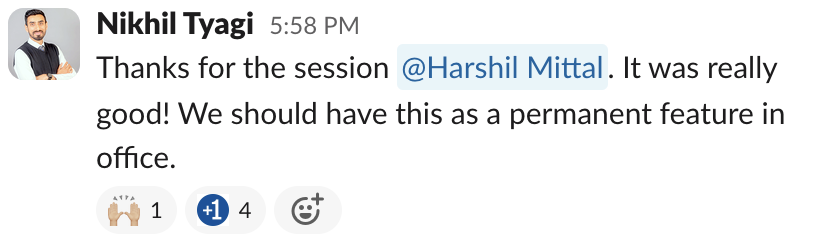
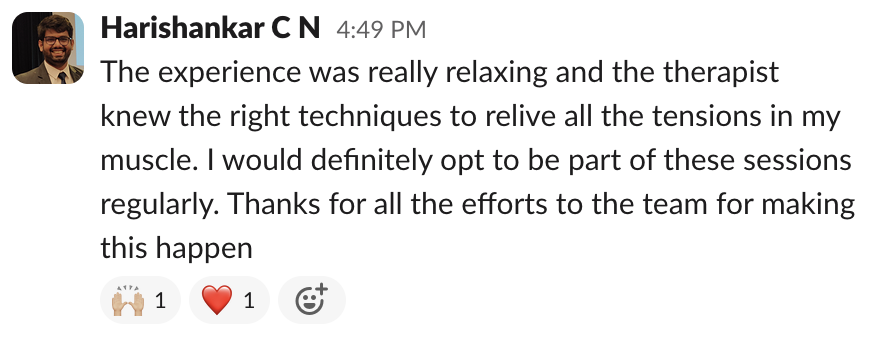
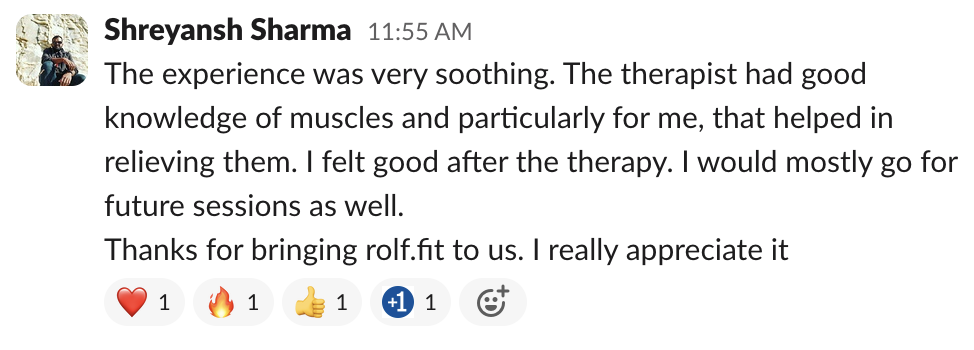
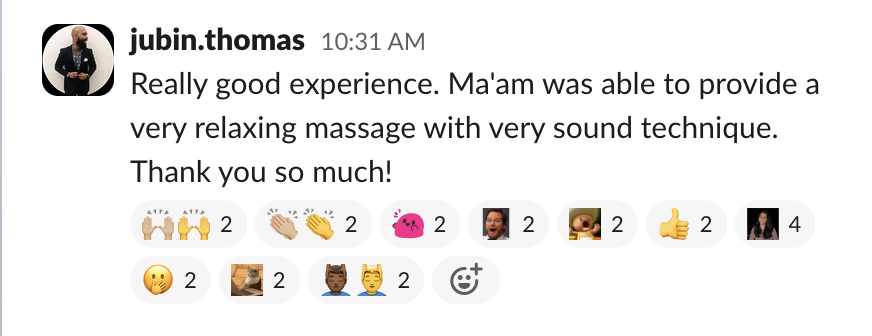
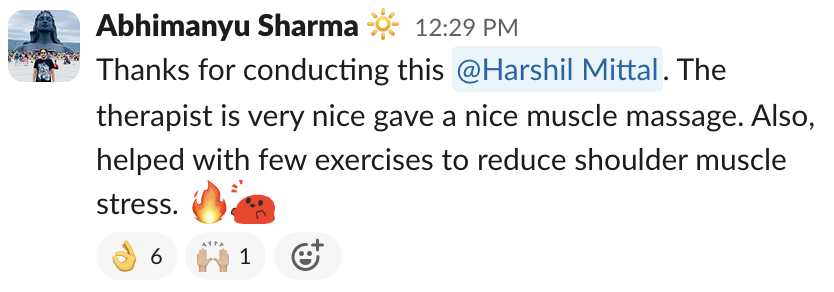
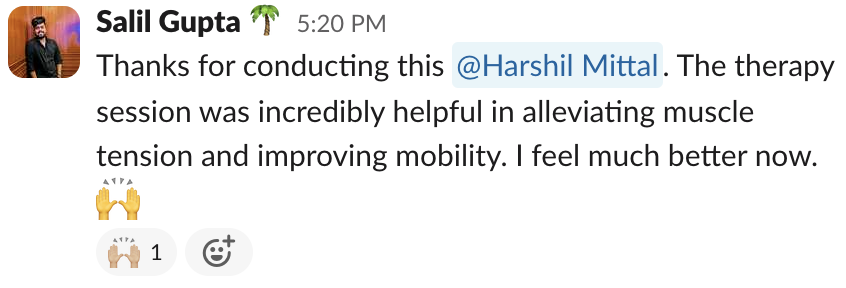
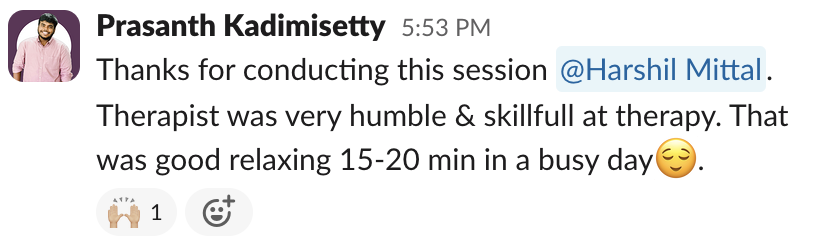
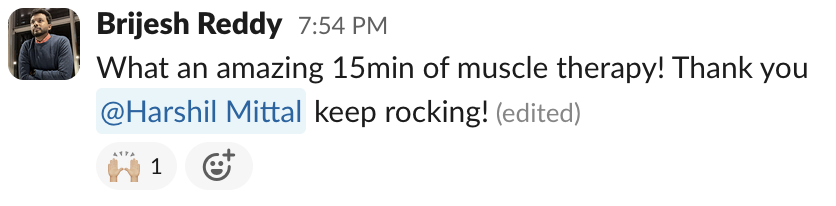
What employees said,
unprompted on Slack.
Real reactions captured from Whatfix's internal Slack channel after sessions.

“We should have this as a
permanent feature in office.”